
Most boiler vs. furnace guides hand you a pros and cons list and call it a comparison. What they skip is the variable that actually determines which system is right for your home — and getting it wrong is a multi-thousand-dollar mistake that compounds for 20 years.
From our field evaluations of real residential heating systems, we’ve found that homeowners who choose based on upfront cost alone consistently end up on the losing side of the equation. Fuel type availability, existing distribution infrastructure, climate demands, and system lifespan all reshape the real cost picture in ways a simple feature comparison can’t capture.
This guide breaks down boilers and furnaces across every decision variable that matters — installed cost, energy efficiency, comfort delivery, maintenance demands, and long-term value — so you can choose the right heating system for your home before the first contractor walks through your door.
TL;DR Quick Answers
Furnace vs Boiler: Which Is the Better Heating System?
Neither system is universally superior. The right choice depends on four variables:
- Existing infrastructure — hydronic or forced-air
- Climate — heating demand and fuel costs in your region
- Budget — upfront installation vs. long-term operating cost
- Indoor air quality needs — circulated air vs. no air movement
Key distinctions at a glance:
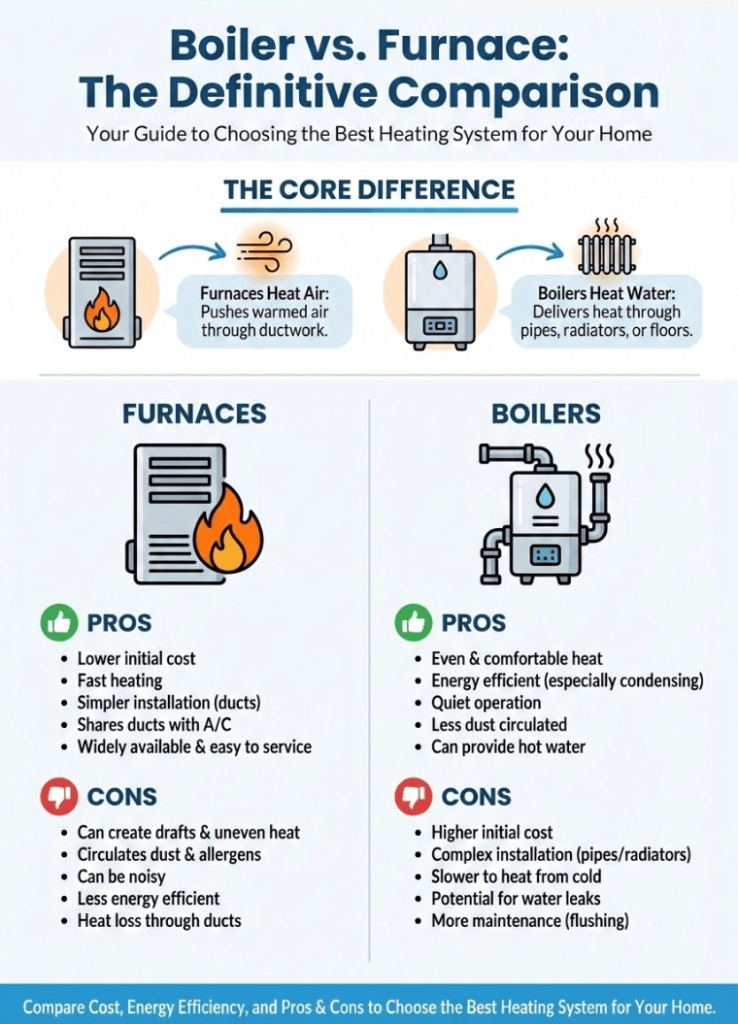
- Furnaces heat air through ductwork. Boilers heat water through pipes, radiators, or radiant floors.
- Furnaces cost less to install: $2,500 to $7,500. Boilers run $3,500 to $10,000+.
- Boilers last longer: 20 to 30 years vs. 15 to 20 years for furnaces.
- Duct losses can erase up to 35% of a furnace’s rated efficiency — a penalty boilers don’t pay.
- New federal standards require 95% AFUE minimum for gas furnaces by late 2028.
From our field evaluations: The most expensive heating mistakes aren’t caused by bad equipment. They’re caused by good equipment selected without accounting for infrastructure condition, duct losses, fuel costs, and the 20-year operating cost arc that follows installation day.
Top Takeaways
- This is a 20-year operating cost decision — not a one-time purchase. Space heating is 42% of total residential energy consumption. The system and efficiency tier you choose today compounds across every heating season for the life of the installation.
- AFUE ratings overstate furnace efficiency in most homes. Duct losses in unconditioned spaces erase up to 35% of rated heat output. That penalty doesn’t exist on a spec sheet — and boilers don’t pay it.
- Existing infrastructure is the most underweighted variable. Retrofitting a boiler without hydronic distribution is a full build-out. Installing a high-efficiency furnace on compromised ductwork is money lost from day one.
- A standard-efficiency furnace installed today will be below the federal minimum by late 2028. New DOE standards require 95% AFUE minimum for non-weatherized gas furnaces. That affects resale value, replacement timing, and operating costs — details most contractor proposals never mention.
- The right system matches your home — not the lowest quote. From our field evaluations, the costliest heating mistakes aren’t bad equipment. They’re good equipment chosen for the wrong reasons.
Table of Contents
What’s the Real Difference Between a Boiler and a Furnace?
Both systems heat your home. That’s where the similarity ends.
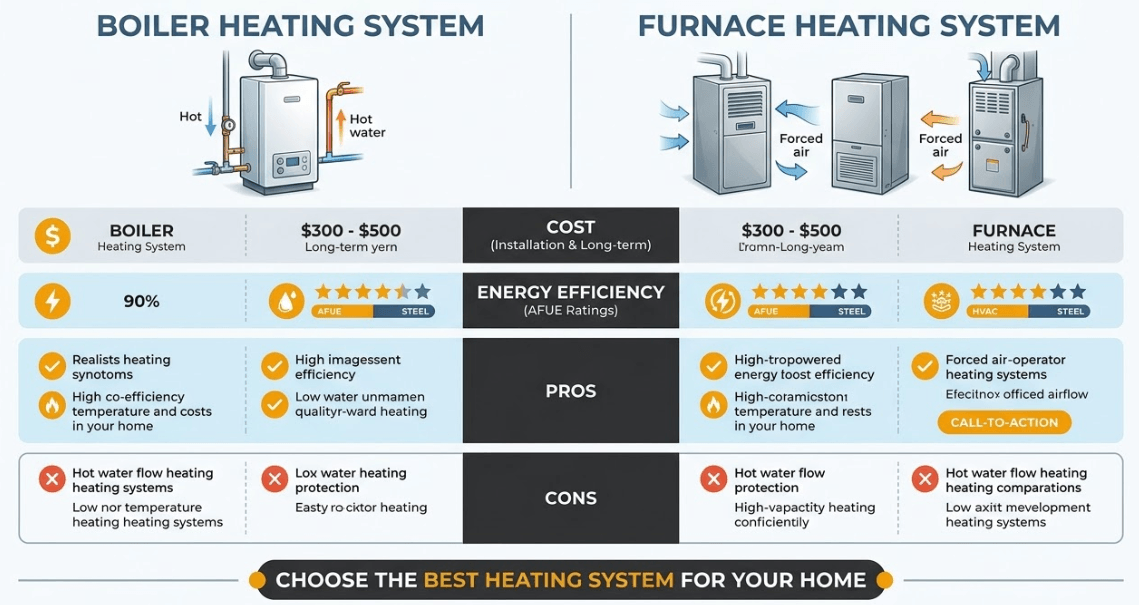
A furnace heats air and pushes it through ductwork. A boiler heats water and delivers that heat through radiators, baseboard units, or radiant floor systems. From our field evaluations, the delivery method is the real decision — it determines installation complexity, comfort quality, and long-term operating cost more than any other variable.
Furnace vs Boiler Cost: What You’ll Actually Pay
A gas furnace typically installs for $2,500 to $7,500. A boiler runs $3,500 to $10,000 or more, depending on system type and whether distribution infrastructure needs modification.
What we’ve consistently observed: retrofit situations drive the biggest cost swings. Installing a boiler in a home with no existing radiators isn’t a swap — it’s a full distribution build-out. Replacing an existing boiler in a home already plumbed for hydronic heat is often straightforward.
Operating costs narrow the gap. High-efficiency condensing boilers reach 90% to 98% AFUE. Top-tier gas furnaces hit 80% to 98% AFUE. In practice, local fuel rates and duct condition matter more than the spec sheet difference.
Energy Efficiency: Which System Costs Less to Run?
AFUE measures what percentage of fuel converts to usable heat — but it doesn’t determine your monthly bill on its own.
Boilers have one key thermal advantage: water retains heat longer than air. Fewer on/off cycles mean less standby loss. In our field evaluations, well-maintained hydronic systems in colder climates frequently outperform comparably rated furnaces on real-world energy use — especially in older homes where duct losses compound furnace inefficiency.
One number worth knowing: DOE research shows duct leakage can reduce forced-air efficiency by 20% to 30% in real-world conditions.
Furnace vs Boiler: Pros and Cons
Boilers:
- Even, consistent heat — no drafts or cold spots
- No ductwork, eliminating a major efficiency loss pathway
- Longer lifespan: 20 to 30 years with proper maintenance
- Better for households with allergy or respiratory sensitivities
- Higher upfront cost, especially in retrofit situations
- Requires a separate cooling system — no shared ductwork for AC
Furnaces:
- Lower upfront installation cost
- Shared ductwork supports central air conditioning
- Faster heat response
- Wider contractor availability
- Vulnerable to duct leakage, which directly erodes efficiency
- Requires consistent filter maintenance to protect airflow and IAQ
Which Heating System Is Right for Your Home?
The right choice comes down to four variables: existing infrastructure, climate, upfront versus long-term cost priorities, and whether you need integrated cooling.
A boiler is the stronger choice for colder climates with existing hydronic infrastructure, households with respiratory sensitivities, and situations where long-term efficiency outweighs higher initial investment.
A furnace is the stronger choice for moderate climates, new construction with shared duct systems, and budgets where upfront cost is the primary constraint.
From our field evaluations, the worst outcomes happen when homeowners choose on equipment price alone — without accounting for distribution condition, fuel costs, and the 20-year operating cost arc that follows installation day.
“In our field evaluations, the homeowners who make the most costly heating system mistakes aren’t choosing between a bad boiler and a good furnace — they’re choosing the right equipment for the wrong home, because nobody walked them through the infrastructure, fuel cost, and 20-year operating reality before the contract was signed.”
Essential Resources: What Every Homeowner Should Review Before Choosing Between a Boiler and a Furnace
Pricing a heating system without understanding efficiency standards, sizing requirements, and contractor qualifications is how homeowners end up with the wrong system — or the right system installed incorrectly. These seven authoritative resources cover the decisions that actually determine what you’ll pay, how your system performs, and what you’ll live with for the next 20 years.
1. How to Determine Whether Retrofitting Your Existing System Beats Full Replacement
Source: U.S. Department of Energy — Gas-Fired Boilers and Furnaces
URL: https://www.energy.gov/energysaver/gas-fired-boilers-and-furnaces
From our field evaluations, full replacement isn’t always the right call — and homeowners who skip this analysis frequently overspend. This DOE resource details retrofit upgrades — vent dampers, intermittent ignition devices, aquastat adjustments — that can recover meaningful efficiency from a sound existing system before replacement costs enter the conversation.
2. How to Verify Whether Your New Furnace or Boiler Qualifies for a Federal Tax Credit
Source: ENERGY STAR — Furnaces & Hot Water Boilers Tax Credits
URLs:
- https://www.energystar.gov/about/federal-tax-credits/furnaces-natural-gas-oil
- https://www.energystar.gov/about/federal-tax-credits/hot-water-boilers-natural-gas-propane-oil
Tax credit eligibility is one of the most consistently overlooked variables in heating system cost planning — and one of the most straightforward ways to reduce total out-of-pocket cost. These ENERGY STAR resources detail the AFUE thresholds required for both gas furnaces and hot water boilers to qualify for the federal Section 25C Energy Efficient Home Improvement Credit, worth up to 30% of installed cost capped at $600.
3. How to Claim the IRS Section 25C Tax Credit for a Qualifying Heating System Installation
Source: IRS — Energy Efficient Home Improvement Credit
URL:https://www.irs.gov/credits-deductions/energy-efficient-home-improvement-credit
Understanding eligibility is only half the equation — filing correctly is what actually reduces your tax bill. This IRS resource covers qualifying equipment requirements, annual credit limits, and how to claim the credit using Form 5695. Homeowners installing a qualifying furnace or boiler should confirm requirements directly from this source before installation is completed.
4. Why Every Heating System Installation Requires a Manual J Load Calculation — Not a Contractor’s Best Guess
Source: ACCA — Manual J Residential Load Calculation
URL:https://www.acca.org/standards/technical-manuals/manual-j
Oversizing is one of the most common and most expensive mistakes in residential heating installation — and it starts with contractors who skip proper load calculations. Manual J is the ANSI-recognized national standard for determining a home’s actual heating requirements. What we’ve observed in real systems is that installations sized without a Manual J calculation consistently underperform, short-cycle, and cost more to operate across their entire lifespan.
5. How Your Heating System Choice Directly Impacts Indoor Air Quality
Source: U.S. EPA — The Inside Story: A Guide to Indoor Air Quality
URL:https://www.epa.gov/indoor-air-quality-iaq/inside-story-guide-indoor-air-quality
Furnaces don’t just distribute heat — they circulate whatever is in your ductwork throughout your living space. This EPA resource covers how forced-air systems, combustion appliances, and ventilation rates interact with indoor air quality. It’s essential reading for any household with allergy or respiratory sensitivities weighing a furnace against a hydronic boiler system that moves no air at all.
6. How to Find and Vet a Qualified HVAC Contractor Before Requesting Installation Quotes
Source: ACCA — Contractor Locator
URL:https://hvac-contractors.acca.org/locator
Not every contractor who submits a quote is operating to the same standard — and in many states, licensing requirements are minimal enough to allow underqualified operators into the market. The ACCA contractor locator identifies nationally recognized HVAC professionals by zip code, giving homeowners a verified starting point for building a qualified bidder list before the first quote request goes out.
Supporting Statistics
Most boiler vs. furnace comparisons give you an efficiency number and a price range. These three statistics reveal what that comparison misses — and what it costs you over 20 years.
1. Space Heating Accounts for 42% of All Residential Energy Consumption — Making System Selection a 20-Year Financial Commitment, Not a One-Time Purchase
The most consistent mistake we observe: homeowners treat this as a purchase decision. It’s an operating cost decision.
Key findings from the U.S. EIA 2020 Residential Energy Consumption Survey (RECS):
- Space heating is the single largest energy end use in U.S. homes — 42% of total residential energy consumption
- Average household spend: $519 annually on space heating
- Cold-climate households pay far more — New Hampshire averaged $981 per year
What this means in practice: Choosing between an 80% AFUE furnace and a 95% AFUE condensing boiler isn’t a $2,000 equipment decision. It’s a decision that compounds across every heating season for 20 years. From our field evaluations, the homeowners who get the best long-term value run the operating cost math before signing — not after.
Source: U.S. Energy Information Administration — 2020 Residential Energy Consumption Survey (RECS)https://www.eia.gov/pressroom/releases/press535.php
2. Duct Losses Can Erase Up to 35% of a Furnace’s Rated Heat Output — a Penalty Boilers Are Structurally Immune To
This is the statistic that dismantles the side-by-side AFUE comparison — and the one we reference most in the field when homeowners treat efficiency ratings as equivalent.
Key findings from the U.S. Department of Energy — Energy Saver:
- Duct losses can consume up to 35% of a furnace’s total energy output when ducts run through unconditioned spaces
- This loss is invisible in AFUE ratings — labeled efficiency consistently overstates real-world delivered performance
- Boilers use sealed pipe distribution — the duct loss pathway doesn’t exist
What we’ve observed in real installations:
- A 96% AFUE furnace with leaky attic ducts can deliver less usable heat per dollar than a 90% AFUE boiler
- Most older homes have ductwork in unconditioned spaces
- This efficiency gap is rarely disclosed — and almost never quantified in a contractor proposal
Source: U.S. Department of Energy — Energy Saver: Furnaces and Boilershttps://www.energy.gov/energysaver/furnaces-and-boilers
3. Residential Gas Furnaces Represent 19% of Annual U.S. Residential Energy Use — and a Federal 95% AFUE Minimum Takes Effect in Late 2028
This is the data point most contractors aren’t volunteering. It changes the total cost of ownership calculation for anyone installing a furnace today.
Key findings from the U.S. Department of Energy’s finalized residential furnace efficiency standards:
- Residential gas furnaces account for approximately 19% of total annual U.S. residential energy use
- New DOE standards effective late 2028 require all non-weatherized gas furnaces to meet a minimum 95% AFUE — condensing only
- Projected consumer savings: $24.8 billion over 30 years
- Projected carbon reduction: 332 million metric tons
The field-level implication most comparisons miss:
- A standard-efficiency furnace installed today falls below the federal minimum within three years of the new standard taking effect
- That regulatory timeline affects resale value, replacement timing, and long-term operating costs
- It’s a hidden variable in the total cost of ownership calculation — one a simple price comparison won’t surface
From our field evaluations, this is exactly the kind of decision variable that separates an informed system selection from an expensive one.
Source: U.S. Department of Energy — DOE Finalizes Energy Efficiency Standards for Residential Furnaceshttps://www.energy.gov/articles/doe-finalizes-energy-efficiency-standards-residential-furnaces-save-americans-15-billion
Final Thoughts
A boiler vs. furnace decision looks straightforward on the surface. Two systems. One job. Heat your home.
What we’ve observed across real residential installations tells a more complicated story — and a more consequential one.
The equipment cost is where the conversation starts. It’s rarely where the real decision lives.
Here’s our field-informed perspective:
Most homeowners who regret their heating system choice didn’t choose the wrong equipment. They chose the right equipment for the wrong reasons — lowest upfront cost, a contractor’s recommendation without a Manual J, or an AFUE comparison that ignored duct losses, fuel rates, and infrastructure realities.
From our field evaluations, the boiler vs. furnace decision consistently comes down to four variables that most comparison guides treat as footnotes:
- Existing infrastructure — retrofitting a boiler into a home without hydronic distribution isn’t a system swap, it’s a build-out
- Duct condition — a high-efficiency furnace on a leaky duct system delivers significantly less than its rated AFUE
- Climate and fuel costs — a 15% efficiency advantage compounds differently in Minnesota than in Georgia
- Regulatory trajectory — standard-efficiency furnaces will fall below the federal 95% AFUE minimum by late 2028
Our honest opinion:
Boilers are underrated in markets where they’ve fallen out of fashion — and furnaces are over-relied on in aging housing stock where duct systems silently erode the efficiency gains homeowners paid a premium for.
Neither system is universally superior. Both can perform exceptionally well. Both can disappoint for 20 years when the selection process prioritizes the wrong variables.
The homeowners who get this right aren’t the ones who found the best equipment. They’re the ones who understood their home’s specific infrastructure, ran the long-term operating cost math, required a Manual J before any system was specified, and chose a contractor whose standard of installation matched the quality of the equipment they were installing.
That’s the decision framework no spec sheet provides — and the one that determines whether a heating system is an investment or an expense.
FAQ on Furnace vs. Boiler
Q: What is the main difference between a furnace and a boiler?
A: The delivery method — and it drives every meaningful difference between the two systems.
- Furnace: Heats air. Distributes through ductwork.
- Boiler: Heats water. Distributes through radiators, baseboard units, or radiant floor systems.
From our field evaluations, this single distinction determines comfort consistency, indoor air quality, installation complexity, and long-term operating cost. It’s not a technical footnote. It’s the decision.
Q: Which is cheaper to install — a furnace or a boiler?
A: Furnaces cost less upfront. But the quote and the true cost are frequently two different numbers.
Typical installed costs:
- Furnace: $2,500 to $7,500
- Boiler: $3,500 to $10,000+
What we consistently observe in real retrofit scenarios:
- Replacing an existing boiler in a home already plumbed for hydronic heat is a straightforward swap
- Installing a boiler with no existing radiators or radiant tubing is a full distribution build-out
- That cost gap narrows — or disappears — once infrastructure condition is factored in
The installation quote is where the conversation starts. Infrastructure condition is where the real cost story lives.
Q: Which is more energy efficient — a furnace or a boiler?
A: Both reach high AFUE ratings. But AFUE is a laboratory metric — not a real-world delivered efficiency number.
Efficiency ranges:
- Condensing boilers: 90% to 98% AFUE
- High-efficiency gas furnaces: 80% to 98% AFUE
What the spec sheet doesn’t show:
- Duct losses in unconditioned spaces erase up to 35% of a furnace’s rated output
- Boilers use sealed pipe distribution — that loss pathway doesn’t exist
- A 90% AFUE boiler frequently outperforms a 96% AFUE furnace running through a leaky attic duct system
From our field evaluations, the AFUE comparison is only valid when duct condition and location are factored in. Most contractor proposals never make that calculation.
Q: Which heating system lasts longer — a furnace or a boiler?
A: Boilers outlast furnaces under comparable conditions.
Typical service life:
- Boiler: 20 to 30 years with proper maintenance
- Furnace: 15 to 20 years with proper maintenance
What we’ve observed in real systems:
- A correctly sized, properly commissioned boiler on a well-maintained hydronic system is one of the most durable mechanical investments a homeowner can make
- A furnace installed without a Manual J load calculation — oversized, short-cycling, running against compromised ductwork — wears prematurely regardless of brand or efficiency rating
Equipment type sets the ceiling. Installation quality determines what you actually get.
Q: Is a boiler or furnace better for homes with allergy or respiratory sensitivities?
A: Boilers hold a clear, structural advantage — and it’s one of the most underreported factors in this comparison.
Why hydronic systems perform better for IAQ:
- Boilers move heat through water — no air circulates through the living space
- No ductwork means no distribution of dust, allergens, or combustion byproducts
- Furnaces circulate whatever is present in the duct system with every heating cycle
What we’ve observed in the field:
- Households switching from forced-air to hydronic heat have reported noticeable improvements in respiratory comfort within a single heating season
- In homes with older ductwork or inadequate filtration, the air quality impact of forced-air systems is measurable
For households where indoor air quality is a primary concern, this structural difference is often the deciding factor — independent of cost or climate.
Ready to Choose the Right Heating System for Your Home?
Explore our complete library of HVAC system guides, cost breakdowns, and contractor vetting resources at ProHVACDigest.com — everything you need to compare a boiler vs. furnace with confidence before the first contractor walks through your door. Have a question about your specific situation? Reach out through our contact page and we’ll point you in the right direction.